Get a quote
TL-04

Brick Calculator: How Many Bricks, Cement and Sand?

Enter your wall size to see the bricks, cement and sand for the job. Then get free quotes from builders and building suppliers.

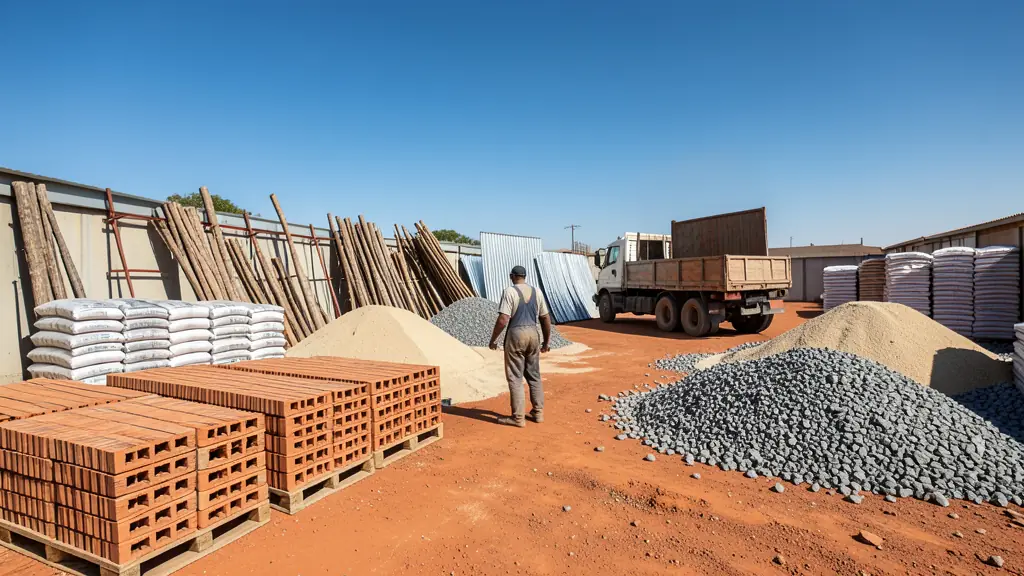
Pallets of face bricks, cement bags and stacked timber at a South African building supply yard

Brick & Mortar Calculator

Change any measurement and the answer updates as you type.

Measuring sheetTL-04
Door about 1.7 m²; window W × H
Standard SA brick 222 × 106 × 73 mm

Bricks to order649 bricks

Net wall area
11.90 m²
Bricks per m²
51.9
Extra for breakage
5%
Mortar (wet, incl. 20% waste)
0.24 m³
Cement
90 kg: 2 × 50 kg bags
Building sand
0.25 m³ (0.4 t)
  • Builders' merchants sell sand by the cube (m³) or ton. A cube of damp building sand weighs roughly 1.5–1.7 tons.
  • Use building sand for mortar; plaster sand is finer and river sand is coarser and better for concrete and screeds.
Estimates only: confirm quantities with your supplier or contractorTL-04

This brick calculator works out how many bricks you need for a wall, plus the cement and building sand for the mortar. It takes off doors and windows, allows for 10 mm mortar joints and adds 5% for breakage. The default brick is the standard South African size of 222 × 106 × 73 mm. These are estimates, so ask your supplier to confirm quantities before you order.

How the calculation works

Net wall area is length times height, less openings. Bricks per m² are 1,000,000 divided by the brick length plus 10 mm, times the brick height plus 10 mm. A double skin wall needs twice as many. The calculator then adds 5% for breakage.

Mortar is the volume of the joints around each brick, plus 20% for waste. Dry materials are 1.3 times the wet volume. The cement is worked out from your mix at 1,440 kg per m³, and the rest is sand, shown in cubes and in tons at about 1.6 t per m³.

Measuring and choosing a mix

  • Measure the wall length and height in metres. Take off a door at about 1.7 m² and each window at width times height.
  • Single skin is a half-brick wall, about 110 mm thick. Double skin is about 220 mm.
  • Use 1 : 3 mortar for foundations, below ground and retaining walls.
  • Use 1 : 4 for general brickwork and 1 : 6, with lime, for light internal walls.

Materials and weather

Cement is sold in 50 kg and 25 kg bags. Sand is sold by the cube (m³) or by the ton. Use building sand for mortar. Plaster sand is finer, and river sand is coarser and better for concrete and screeds.

Keep cement dry and cover fresh brickwork when rain is coming, which on the Highveld means summer storms and hail, and in the Western Cape the winter rain. In hot dry weather, wet the bricks first so they do not pull water out of the mortar.

When to call a professional

New buildings, extensions, structural changes and many boundary walls need plans approved by the municipality under the National Building Regulations and Building Standards Act (Act 103 of 1977). Ask the municipality before you build. Retaining walls and tall walls also need proper design.

Use the form on this page to get a free quote from a builder or supplier. HandymanService.co.za does not do the work itself. It passes your request to independent contractors and suppliers.

Frequently asked questions

How many bricks do I need for a 6 m wall?
A single skin wall 6 m long and 2.4 m high, less 2.5 m² of openings, needs about 650 bricks including 5% breakage. A double skin wall needs about twice that. Enter your own height and openings for a more accurate figure.
What is the difference between single and double skin?
A single skin wall is one brick wide laid on its side, about 110 mm thick. A double skin wall is two brick widths, about 220 mm thick, so it needs twice as many bricks and more mortar. Boundary and load-bearing walls are often double skin.
Which mortar mix should I use?
Use 1 : 4 cement to sand for general brickwork. Choose 1 : 3 where the wall is stronger, such as foundations, below ground or retaining work. A 1 : 6 mix with lime suits light internal walls. Ask your builder if you are unsure.
Can I enter a different brick size?
Yes. The defaults are the standard SA brick of 222 × 106 × 73 mm. Change the length, height and width to match the bricks you are buying. The calculator keeps a 10 mm mortar joint, so check with your supplier if you plan a different joint.

More calculators and guides

Get a free quote

Tell us the job and where it is. A handyman, contractor or supplier who works in your area quotes you directly.

Job cardNo. 80907
  1. 1Tick the jobs and describe the work.
  2. 2We pass it to someone who works near you.
  3. 3They quote you. Free, no obligation.
Tick what needs doing (optional)

Free and no obligation. By sending you agree that we may share your request with a suitable handyman, contractor or supplier. See our privacy policy.

Get a free quote