Get a quote
TL-02

Tile Calculator: How Many Tiles, Adhesive and Grout?

Find out how many tiles to buy, plus the adhesive and grout to go with them. Then get free quotes from tilers and tile suppliers.

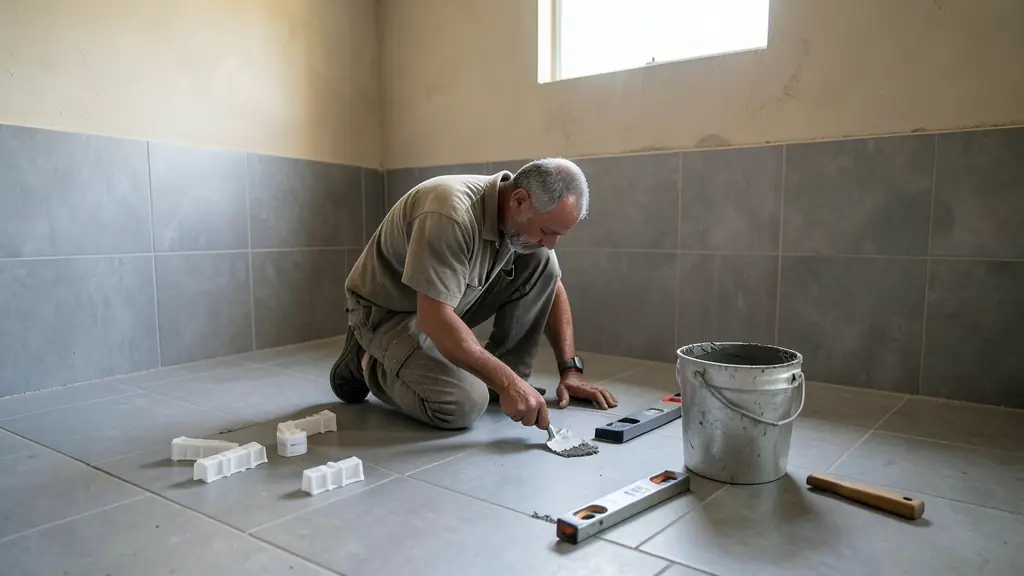
A tiler laying large grey floor tiles in a South African bathroom with spacers and a level

Tile, Adhesive & Grout Calculator

Change any measurement and the answer updates as you type.

Measuring sheetTL-02
Add splashbacks, steps or wall strips
Rectified tiles 2–3; floors 3–5; rustic 6–10
On the box; 60×60 is often 4

Tiles to buy37 tiles (10 boxes)

Area to tile
12.00 m²
Tiles per m² (with joints)
2.8
Extra for cuts and breakage
10%
Area covered by the boxes
14.40 m²
Tile adhesive (about 5.5 kg/m²)
73 kg: 4 × 20 kg bags
Grout
1.9 kg: 1 × 5 kg bags
  • Tiles over 600 mm usually need back-buttering as well, which is why the adhesive rate goes up for large formats.
  • Keep one or two spare tiles from the same batch for future repairs: shades vary between batches.
Estimates only: confirm quantities with your supplier or contractorTL-02

This tile calculator shows how many tiles to buy for a floor or wall, plus the tile adhesive and grout. Enter the area, tile size, grout joint and layout. The calculator adds extra for cuts and breakage, rounds up to whole boxes, and works out the 20 kg bags of adhesive and 5 kg bags of grout. These are estimates, so check the adhesive and grout data sheets before you buy.

How the calculation works

Tiles per square metre are 1,000,000 divided by the tile length plus the joint, times the tile width plus the joint, all in millimetres. That is multiplied by your area, then increased for waste: 10% for a straight lay, 12% for brick bond and 15% for diagonal or herringbone. The result is rounded up to whole boxes.

Adhesive is about 4 kg per m² for tiles up to 300 mm, 5.5 kg for tiles up to 600 mm and 7 kg for anything larger, plus 10% spare. Grout uses the standard estimate: tile length plus width, divided by length times width, times tile thickness, times joint width, times 1.6, plus 10%.

Measuring and choosing sizes

  • Measure the length and width in metres. Split an L-shaped room into rectangles and add them together.
  • Use the extra area box for splashbacks, steps and wall strips.
  • Take the tile size and thickness from the box, in millimetres.
  • Joints are usually 2 to 3 mm for rectified tiles, 3 to 5 mm on floors and 6 to 10 mm for rustic tiles.

Buying tiles in South Africa

Tiles come in boxes, adhesive in 20 kg bags and grout in 5 kg bags. Buy everything from one batch, because shades vary between batches. Keep a spare tile or two for future repairs.

Tiles over 600 mm usually need back-buttering as well, which is why the adhesive rate goes up for large formats. In bathrooms and on damp coastal walls, waterproof the surface first and follow the adhesive's cure times on the data sheet before you grout.

When to call a professional

Ask a tiler for help with large-format tiles, showers, uneven floors or herringbone patterns. These jobs need a flat base and careful setting out, and mistakes are costly to lift.

Use the form on this page to get a free quote from a tiler or tile supplier. HandymanService.co.za does not do the work itself. It passes your request to independent handymen, contractors and suppliers.

Frequently asked questions

How many tiles do I need for a 12 m² floor?
With 600 × 600 mm tiles, a 3 mm joint and a straight lay, a 4 × 3 m floor needs about 37 tiles. That is 10 boxes of four. The total includes 10% extra for cuts and breakage. Change the tile size or layout and the numbers update.
Why does the calculator add extra tiles?
Tiles get cut at walls and corners, and some break. The calculator adds 10% for a straight lay, 12% for brick bond and 15% for diagonal or herringbone, because these layouts need more cuts. Extra tiles also let you repair the floor later with the same batch.
How much tile adhesive will I need?
The rate depends on the biggest tile side: about 4 kg per m² up to 300 mm, 5.5 kg up to 600 mm and 7 kg above that, plus 10% spare. A 12 m² floor of 600 mm tiles needs about 73 kg, or four 20 kg bags.
What grout joint width should I use?
Rectified tiles are usually laid with 2 to 3 mm joints. Floor tiles often use 3 to 5 mm, and rustic tiles 6 to 10 mm. The tile maker's advice on the box comes first. A wider joint needs more grout and slightly fewer tiles.

More calculators and guides

Get a free quote

Tell us the job and where it is. A handyman, contractor or supplier who works in your area quotes you directly.

Job cardNo. 25770
  1. 1Tick the jobs and describe the work.
  2. 2We pass it to someone who works near you.
  3. 3They quote you. Free, no obligation.
Tick what needs doing (optional)

Free and no obligation. By sending you agree that we may share your request with a suitable handyman, contractor or supplier. See our privacy policy.

Get a free quote