Get a quote
TL-01

Paint Calculator: How Much Paint Do You Need?

Work out the litres of paint for a room in under a minute. Then ask local painters or paint suppliers for a free quote.

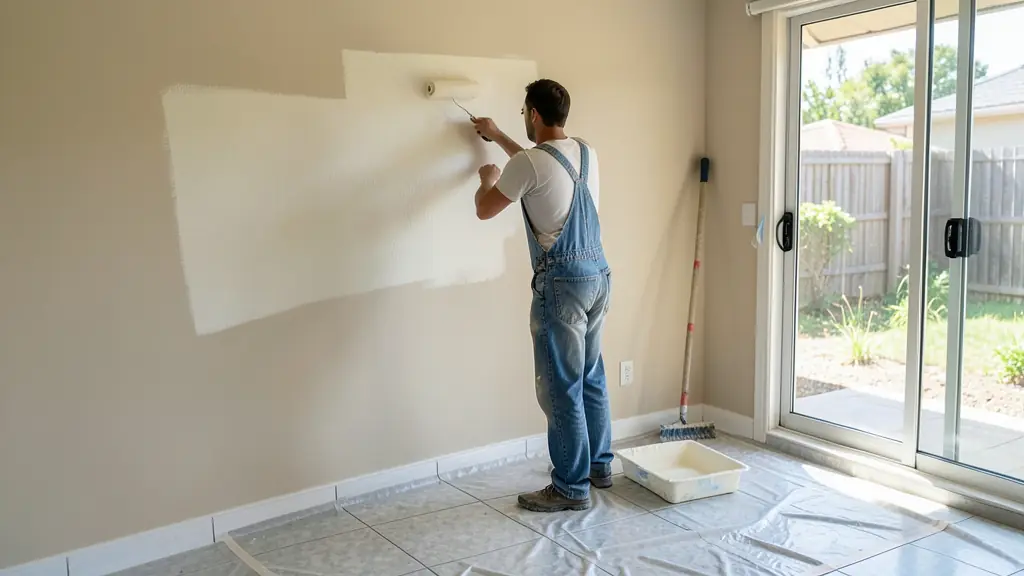
A painter rolling off-white paint onto a freshly prepared living room wall in a South African home

Paint Calculator

Change any measurement and the answer updates as you type.

Measuring sheetTL-01
Most SA homes: 2.4–2.7 m
Each about 1.6 m²
Each about 1.5 m²
2 for a colour change; 3 for dark to light
Smooth plaster 8–10; rough plaster or face brick 4–6

Paint needed7.6 litres

Wall area (less doors and windows)
34.4 m²
Area to paint
34.4 m²
Total coverage needed
68.8 m² (2 coats)
Suggested tins
1 × 5 L + 3 × 1 L
  • Buy all the topcoat from one batch, or mix the tins together in a bucket, so the colour matches on every wall.
  • Rough, porous or freshly plastered walls soak up more: lower the coverage figure or add a coat.
Estimates only: confirm quantities with your supplier or contractorTL-01

This paint calculator works out how many litres you need for walls, a ceiling or both. It measures the wall area, takes off doors and windows, multiplies by the number of coats and divides by the coverage of your paint. It then suggests a mix of 20 L, 5 L and 1 L tins. Every figure is an estimate, so check the coverage on the paint's data sheet before you buy.

How the calculation works

Wall area is twice the length plus the width, times the wall height. The calculator then takes off about 1.6 m² for each door and 1.5 m² for each window. A ceiling is simply length times width.

Litres needed are the area, times the number of coats, divided by the coverage in square metres per litre. The default is 9 m² per litre. Smooth plaster is usually 8 to 10. Rough plaster or face brick is 4 to 6, so lower the figure for those surfaces.

Tick the primer box and the calculator adds one coat of primer or undercoat at the same coverage.

Measuring the room properly

  • Measure the length and width of the room, and the height from floor to ceiling. Most SA homes have walls 2.4 to 2.7 m high.
  • Count every door and window. Ignore small items like switches and plug points.
  • Choose 2 coats for a colour change and 3 coats when going from dark to light.
  • Rough, porous or freshly plastered walls soak up paint, so lower the coverage or add a coat.

Tins, weather and timing

Paint is commonly sold in 1 L, 5 L and 20 L tins. Buy all the topcoat for a room in one batch, or mix the tins together in a bucket, so the colour matches on every wall.

For outside walls, choose your season. In summer-rainfall areas such as Gauteng and KZN, the dry winter months are best, because thunderstorms and hail are common from October to March. In the Western Cape the dry summer is the better time. On the coast, wash off salt and let damp walls dry before you paint.

When to call a professional

Call a painter for high ceilings, damp patches, peeling paint or a whole house. A good painter will find and fix the cause of damp first, because paint over damp fails quickly.

Use the form on this page to get a free quote from a painter or paint supplier near you. HandymanService.co.za does not do the work itself. It passes your request to independent handymen, contractors and suppliers.

Frequently asked questions

How many litres of paint do I need for a bedroom?
It depends on the size. With the default room of 4 m by 3.5 m, 2.6 m walls, one door, two windows and two coats, the walls need about 7.6 litres. That is one 5 L tin and three 1 L tins. Change the sizes to match your own room.
How much does one litre of paint cover?
The calculator assumes 9 m² per litre for one coat. Smooth plaster is usually 8 to 10 m², while rough plaster or face brick is 4 to 6 m². Products differ, so check the data sheet on the tin and enter that figure instead.
How many coats of paint should I plan for?
Plan for 2 coats for a normal colour change. Use 3 coats when painting a light colour over a dark one. Bare or freshly plastered walls also need a primer or undercoat first, which you can add with the tick box.
Should I include the ceiling?
Choose walls and ceiling if you will paint both. The calculator then adds the ceiling area, which is length times width. Ceilings are often painted with a different product, so you may prefer to run the ceiling on its own and buy that paint separately.

More calculators and guides

Get a free quote

Tell us the job and where it is. A handyman, contractor or supplier who works in your area quotes you directly.

Job cardNo. 79845
  1. 1Tick the jobs and describe the work.
  2. 2We pass it to someone who works near you.
  3. 3They quote you. Free, no obligation.
Tick what needs doing (optional)

Free and no obligation. By sending you agree that we may share your request with a suitable handyman, contractor or supplier. See our privacy policy.

Get a free quote